.png)
Life Insurance Layering: How to Get the Right Coverage Without Overpaying


When you think about life insurance, you may picture one big policy that you buy, tuck away in a file somewhere, and hopefully never have to think about again.
But your financial life isn’t static. The amount of protection your family needs when you’re 42, raising kids and paying a mortgage, may look very different from what you need at 55, when college is nearly behind you, your savings have grown, and retirement is getting closer.
That’s where life insurance layering – also called laddering - can make sense. Instead of buying one large policy designed to cover every possible need for the next 20 or 30 years, layering uses multiple policies with different coverage amounts and timeframes.
The goal is simple: match each policy to a real financial responsibility, then let coverage reduce as those responsibilities naturally fall away.
Why Your Life Insurance Needs May Shrink Over Time
For many professional women, their 40s and 50s can be some of their highest-earning years. They can also be some of their most financially demanding.
You may be simultaneously:
Paying down a mortgage
Supporting children or helping with college
Building retirement savings
Caring for or financially assisting aging parents
Growing a business or advancing into a higher-level position
If something happened to you today, your family might need substantial financial support to replace your income and keep all of those plans moving forward. Fast-forward 15 years, though, and the picture could be very different. The mortgage may be much smaller or gone entirely. The kids may be financially independent. College tuition may be a distant memory. Your retirement accounts and other assets may have grown over time.
In other words, the financial gap that life insurance needs to fill may naturally get smaller.
So why pay for the same amount of coverage the entire time?
What Layering Can Look Like
Imagine Maya, a 42-year-old executive with two children, a 20-year mortgage, and a goal to help pay for college. Instead of purchasing one $1.5 million, 30-year policy, she might divide her coverage into layers:
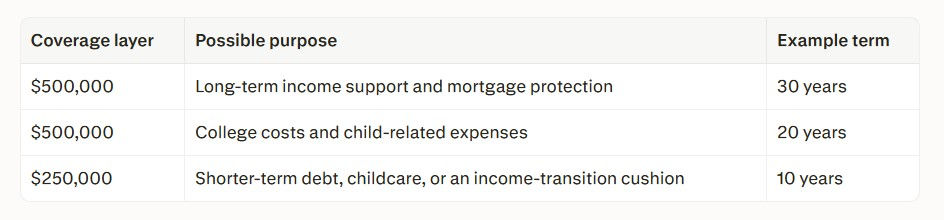
For the first 10 years, Maya has $1.25 million in total coverage. After the shortest policy ends, her coverage drops to $1 million. Once the college-focused policy ends, she still has $500,000 in place for the longer-term needs that remain.
Why This Approach Can Be Especially Important for Professional Women
Women are often carrying several financial roles at once: earner, partner, parent, household organizer, caregiver, and sometimes business owner. That means the financial impact of losing you could extend far beyond your paycheck. Maybe you’re the one coordinating childcare, managing the household calendar, helping an aging parent, handling the family finances, or keeping a business running. If someone else suddenly had to take on—or pay for—those responsibilities, the costs could add up quickly.
That’s why life insurance shouldn’t be based on salary alone. The conversation should include everything you contribute to your family’s financial life, including the work that doesn’t come with a paycheck. The goal is to give the people you love enough breathing room to maintain their lives, make thoughtful decisions, and adjust to a new financial reality without immediately having to worry about how every bill will get paid.
How Do You Figure Out How Much Coverage You Need?
Before you start comparing policies, it can help to think about what you actually want the insurance to cover and how long you'll need it. Not every financial responsibility sticks around forever.
For example:
Your mortgage: You may only need this coverage until the house is paid off.
Childcare: Those costs usually decrease as your kids get older and more independent.
College: If helping with tuition is a priority, there's a pretty clear finish line.
Replacing your income: You may need more coverage during your peak earning and family years, and less once you've built up savings and retirement assets.
Final expenses: This is a lifelong consideration, but it's typically a much smaller need than replacing years of income.
Looking at your needs this way can make life insurance feel a lot less like guessing at one giant number. You may discover that some needs call for shorter-term coverage, while others make sense to protect for much longer.
It's also a good reminder not to count too heavily on the life insurance you have through work. Employer coverage is a nice benefit, but it may disappear when you change jobs or retire. Having coverage that's yours and not tied to your employer can give you a little more control over your plan.
Also remember that layering is not automatically the best fit for everyone. Before buying or replacing coverage, consider:
Your health and insurability today, since purchasing later can be more expensive or more difficult.
Whether each policy has level premiums for the full term.
Whether a term policy includes a conversion option if lifelong coverage could become important later.
Existing coverage through work, individual policies, and any coverage owned by a spouse or partner.
Beneficiary designations, which should be reviewed after major life events.
Your estate plan, especially if you have a blended family, children from a prior relationship, a business, or significant assets.
Is Your Life Insurance Still a Fit?
If it’s been a few years since you looked closely at your life insurance, it may be worth reviewing how your coverage fits into your larger plan.
At Life Story Financial, we look at insurance as one piece of the bigger picture. The goal is to make sure the protection you have today supports where you are now and where you're headed next.
CLICK HERE to make an appointment.



Comments